Friday, January 19, 2007

Begonia Blogging

click photo for larger view

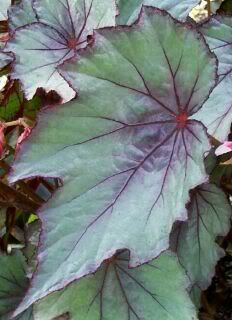
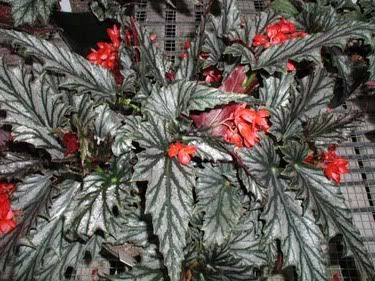
A stunning specimen of Begonia 'Benitochiba', from the Yahoo Begonia Group. This Japanese hybrid with silvery leaves, dark green veins and hints of lavender, is a favorite of mine, although begonias with silvery leaves are usually more prone to mildew and harder to grow.

More begonias

Labels: ,

Saturday, May 13, 2006

Blue Rose

Photobucket - Video and Image Hosting


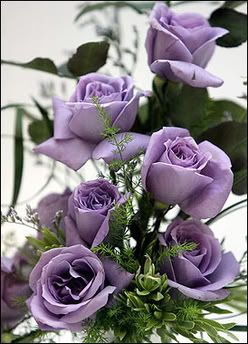
For as long as I can remember, rose enthusiasts have tried to hybridize a blue rose. Now the Japanese brewer Suntory is touting "the world's first blue roses" at the World Rose Convention in Osaka. I don't know about you, but to my eyes, that's lavender, not blue.

Labels:

Saturday, April 01, 2006

Begonia Blogging


Click for larger image

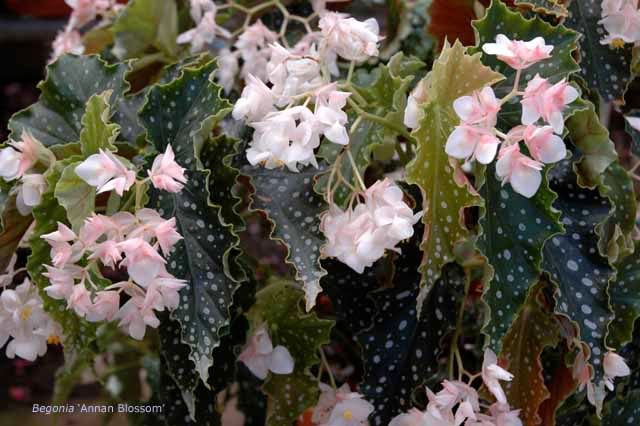
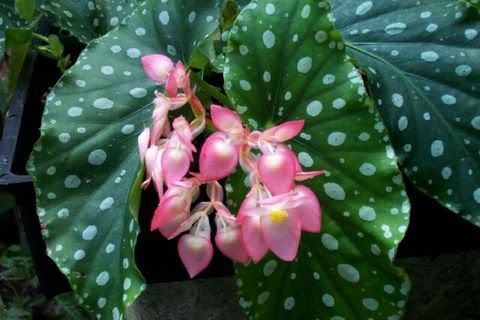
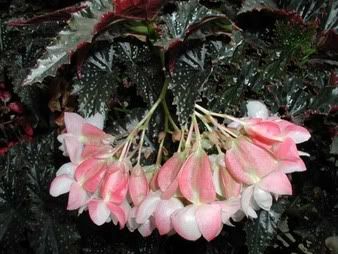
Begonia 'Annan Blossom'. Another beautiful shot from the Yahoo Begonia Group. This is a Ross Bolwell hybrid from 1996, a very compact growing cane with dense foliage, rich green, spotted white, with undulate margins and a white drip tip.

Labels: , ,

Saturday, March 04, 2006

Alocacias

Image hosting by Photobucket

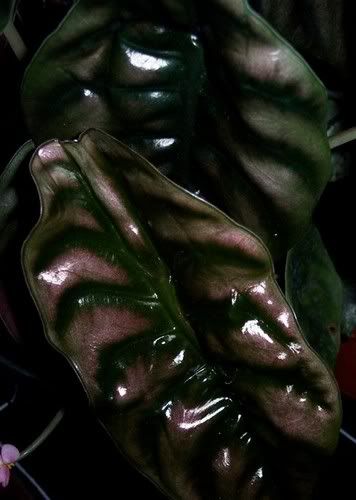
This is a little dark, but I don't have a better shot at the moment. Alocasia cuprea has an odd juvenile leaf that looks heavily shellacked. I've never read about any speculation on what the purpose of that would be. I can't imagine one, unless it's to help prevent fungus. It's a small plant, growing only about 50 cm tall, with leaf blades about 30 cm long.

Alocasias belong to the family Araceae, one of the largest plant families, which includes philodendrons, anthuriums, colocasias, amorphophallus, xanthosomas, and many other genera.

Image hosting by Photobucket

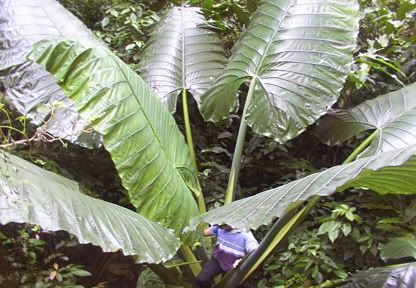
Contrasting with species like A. cuprea, which grow close to the rainforest floor, are alocasias with the largest leaves of any herbaceous plants in Nature, such as Alocasia robusta, whose leaves can reach 10 meters in height. Click here for a truly awesome photo of Alocasia robusta, growing in the wild in Sarawak.

Labels: ,

Saturday, February 25, 2006

Eye Candy

Image hosting by Photobucket

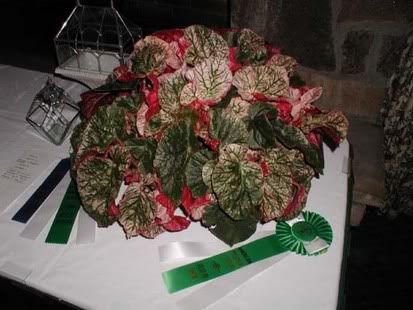
This specimen of the extremely difficult to grow Begonia 'Midnight Sun' earned a much-deserved Best Of Show at one of the recent ABS conventions. It was most likely a Texas or California convention. Apologies to the grower and the photographer, because I didn't save the info. The striking foliage is fantastically variegated, with bright pink, pale pink, dark green and red coloration mixed throughout. Who needs flowers when the leaves are so colorful? The photo is from the wonderfully informative Yahoo group on Begonias.

Labels: ,

Friday, November 18, 2005

Just Because

Image hosted by Photobucket.com

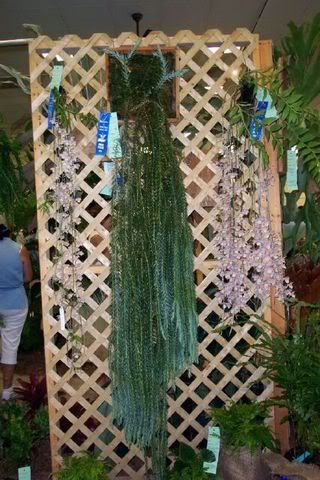
I love to plantblog. Three blue ribbon winners from the Tropical Fern and Exotic Plant Show in Miami last year. The middle one is a species of Lycopodium, an ancient plant and fern ally. It's flanked by two entries of the same orchid. I grow it, but don't remember the name. Orchids aren't really my thing. The few that I have are tied onto trees and pretty much take care of themselves.

Each year this orchid produces new shoots with leaves, like the ones you see at the top of the plant. These grow longer and longer as the plant ages. The following year, the old stems sprout flowers all the way down to the tips. As the plant gets older and has more and more flowering stems, it puts on a spectacular display.

Labels:

Sunday, November 13, 2005

Gone With The Wind

Image hosted by Photobucket.com

Begonia 'Little Miss Mummey', another victim of Hurricane Wilma.

Labels: ,

Friday, October 14, 2005

Aristolochia gigantea

Image hosted by Photobucket.com

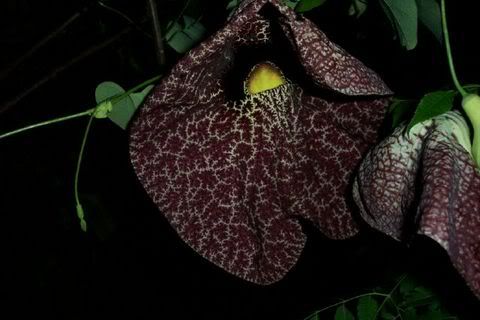
I took this picture of Aristolochia gigantea at night. It's climbing up the chinaberry tree and rambling through the Xanthosoma esculenta (Elephant Ear) area. At around 8" long, the flower is like Aristolochia elegans (Dutchman's Pipe) on steroids. It's a major food source for the larvae of the swallowtail butterfly, so I don't often find flowers that are intact. It always reminded me of grandma's calico dress. The velvety black interior and the bright yellow center are just gorgeous.

Labels:

Saturday, October 01, 2005

Random Begonia

Image hosted by Photobucket.com

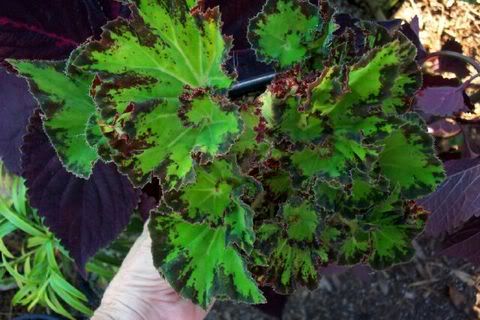
Begonia 'River Nile' is one of many unique rhizomatous hybrids by Brad Thompson, in California. I love the neon lime green centers and dark burgandy edges, as well as the double helix at the umbo. The plant pictured is only in a 4" pot, but the leaves are easily 5" across. I once had a 10" hanging basket of it growing in an enormous rounded mound and spilling over the sides. You can grow a lot of begonia in a small pot.

As with most rhizomatous begonias, flowering occurs from late winter to mid-spring. This shot of B. 'River Nile' flowers was taken at night. Most of the blooms haven't opened yet, but you can see two open female flowers on the lower left.

Image hosted by Photobucket.com

Labels: ,

Sunday, September 11, 2005

Begonia nelumbiifolia

Image hosted by Photobucket.com

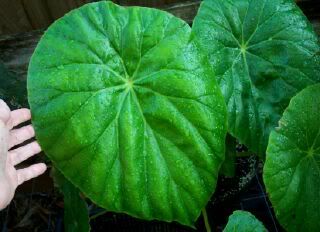
One of several forms of B. nelumbiifolia, a species from Mexico and Central America with a large, peltate leaf. The leaves actually get larger than the ones in the picture next to the disembodied hand. It's quite easy to grow here in South Florida, and often used in the landscape.

Image hosted by Photobucket.com

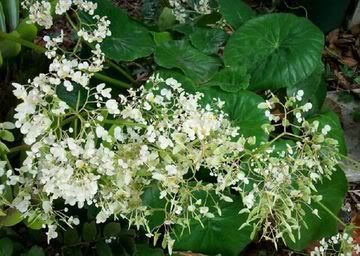
It's profuse white flowers on tall stalks appear from mid winter to late spring.

Labels: ,

Saturday, August 27, 2005

Begonias I Can't Grow

Image hosted by Photobucket.com

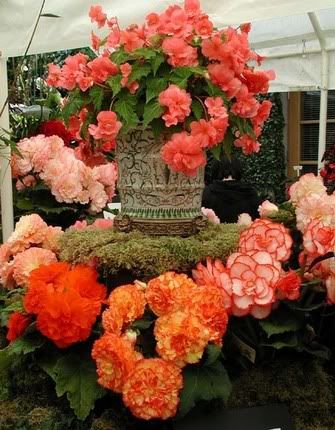
I'm posting this picture of a gorgeous display of tuberous begonias, even though it's the one type that I can't grow in the subtropics. Tuberous begonias require cool nights, and to say that we don't have them is an understatement. Except in the winter, of course, but by then the tubers are dormant. I believe that this picture was taken by Mike Flaherty, a superb grower in Santa Monica, California.

Tuberous begonia species were found in the highlands of South America and Asia. The nights are quite cool in the mountains, and that requirement remained, even after extensive hybridization. Parts of California and the Pacific Northwest, some of the mountainous areas of the US, and some parts of Australia can grow them. But the premier growers and hybridizers of tuberous begonias are in Scotland. I was fortunate to have met Hugh McLaughlin, of Edinburgh, who has been to many of our American Begonia Society conventions. He always gives a talk and slide presentation, showing off the dinner plate-sized flowers that he grows.

Labels: ,

Sunday, August 21, 2005

Begonia of the Fortnight

Image hosted by Photobucket.com

I forgot to post one last week.

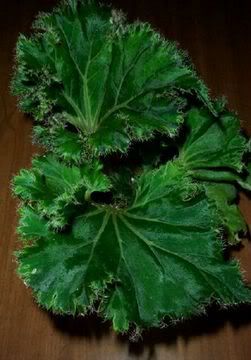
The Begoniaceae family probably has the greatest variety of leaf shape, size, patterning and texture of any plant family, but even plain green can be dramatic. This rhizomatous hybrid, B. 'Oliver Twist', is a lovely shade of (what?) forest green? emerald green? I need a list of all the shades of green. It has a few very dark green, almost black, streaks here and there, which don't show up in the picture. I love the helix and the frilly edges...reminds me of a petticoat.

Labels: ,

Saturday, August 06, 2005

Brazilian Species U043

This begonia is rare even among collectors and has unique characteristics that make it one of the most intriguing species I've ever seen. The gray-green leaves can get nearly a foot across. The edges fold inward, giving them an umbrella-like appearance. The backs of the leaves are a striking burgandy color, and there are red scale-like appendages up and down the petioles.

New leaves emerge looking like crab claws.

This species, which used to be called Rudy's [Ziesenhenne] J-11, has not yet been officially named. It has been given a U (unidentified) number until a positive ID is made, and has been classified as a thick-stemmed begonia. This is one of those begonias that collectors put at the top of their wish list.

Labels: ,

Saturday, July 30, 2005

Begonia acetosa

Image hosted by Photobucket.com

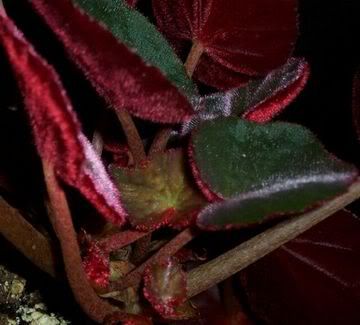
B. acetosa is a species from Brazil with leaves like plush velvet. This photo doesn't do them justice, but it gives you an idea. The leaves are just as soft and fuzzy as they look.

Labels: ,

Saturday, July 23, 2005

Begonia 'Dale Sena'

Image hosted by Photobucket.com
B. 'Dale Sena' (deliciosa x 'Bob Cochran') is a hybrid by Tim Anderson, owner of Palm Hammock Orchid Estate. It has rex characteristics in the leaf coloration, but in growth habit it's more rhizomatous, jointed at or below the soil. Tim is a grower and hybridizer from Miami who has attempted to create crosses which will withstand our summer heat. Begonias are more comfortable in the same temperatures that humans are comfortable in. This one does seem to stand up better to summer temperatures than other rexes. I love the lavender and seafoam green colors in the leaves, which can reach 6"-7" from top to drip point.

Dale Sena is curator of the Begonia Species Bank at the University of South Florida, in Tampa. There are only two begonia species banks in the US. The other is in Ft. Worth, Texas.

Labels: ,

Saturday, July 16, 2005

Begonia U192


This lovely little species from the Philippines, B. U192, has always been a favorite. A delicate looking begonia with sparkly pink leaves, it's classified as a trailing/scandent; it trails along the rainforest floor and occasionally climbs. In tropical and subtropical climates it makes a beautiful ground cover, but it can also be grown in a hanging basket. The one in the picture is growing in a shallow tray. When the light hits the leaves they sparkle with thousands of tiny built-in reflectors. It blooms almost year-round.

Incorrectly called 'Martin's Mystery' by some growers, this is actually an unidentified species. U numbers are given to species until they can be officially identified. In the past when new species were found and named, it was often later discovered that the same plant had already been found and named in the past. This caused a lot of confusion. Giving new species U numbers avoids that problem. I wish they would hurry up on this one. It deserves a name that suits its almost magical cuteness.

Labels: ,

Friday, July 01, 2005

Begonia 'Flamingo Queen'

Image hosted by Photobucket.com

This one is an Australian hybrid by Ross Bolwell, another prolific hybridizer who keeps churning out one beauty after another. Unfortunately, because of import/export restrictions on plants, it's very difficult to get our hands on any of them. This cultivar made it to the US somehow, and I've been growing one for several years now.

B. 'Flamingo Queen' is my favorite cane-like begonia, with a height of 3'-4', prolific pink bloom clusters and enormous, long, curling spotted leaves. I've often thought that Ross really meant 'Flamenco Queen', instead of 'Flamingo Queen', because the leaves remind me of a gypsy dancer's skirt.

Labels: ,

Tuesday, June 28, 2005

Taiwan Hybrid Adenium

Image hosted by Photobucket.com

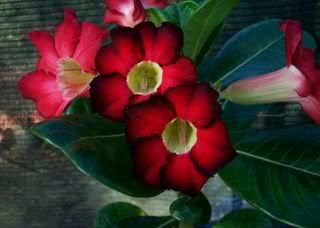
The Thais have become famous in recent years for their spectacular hybrid creations of many genera. A couple of years ago I was given some seeds of Thai hybrid adeniums. Being seeds of hybrids they would never look exactly like the parent plant, and interesting variations are always possible. This is the first one of my seedlings that bloomed. The bright red flowers with a black edge are similar to some pictures I've seen, but are more dramatic. The only way to get an exact duplicate of this plant would be to graft pieces of it onto other plants. I'm trying to think of a name.

Labels:

Saturday, June 25, 2005

Begonia of the Week #5

Image hosted by Photobucket.com

Begonia 'Lady Prado', a Brad Thompson hybrid. I love the bright orange flowers contrasting with the silver-patterned leaves. Brad is a prolific hybridizer in California with many mouth-watering creations. His Web site is the most complete reference on begonia cultivation that I've found.

Labels: ,

Friday, June 17, 2005

Begonia of the Week #4

There are several rex begonia hybrids that look very similar, but I think this one is B. 'Harmony's Red Robin 2'. Impossible to capture in a photo is the sparkle that you find in begonia leaves, especially in rexes. Up close, this looks like the metallic red paint used on cars. Botanists speculate that it may be a device to reflect more light to the plant, since begonias are shade lovers and often grow on the jungle floor. It's magical, whatever it is.

Labels: ,